

What Our Students Learned About Brachot: Blessings Before and After We Eat
Updated: Jun 24
This EmPower thru Learning post shares what students at Perth Hebrew Congregation learned over a few weeks on brachot, the Jewish blessings said over food. They played a blindfold taste-test game, sorted foods into their six blessings, and learned why we say a blessing both before and after eating.
Program: EmPower thru Learning — learning Judaism and Hebrew Location: Perth Hebrew Congregation, Menora Audience: Students, Families Theme: Hakarat hatov, recognising the good before and after we eat Key idea: A bracha is a pause that turns eating into a thank you Try at home: Play a round of the Match the Bracha game before dinner |
What we did
We spent a few weeks on one small question that turns out to be bigger than it looks: what do you say before you eat, and why do we stop to say anything at all?
Students meet this every single day. You eat an apple, drink some water, grab a biscuit. We wanted them to know what to say over each one, and to understand the point of stopping to say it.
We started blindfolded. Every student was blindfolded, given a food, and had to guess what it was. Then the whole group said the blessing for it together, out loud, before anyone took a bite.
Closing your eyes slows the whole thing down. You stop, pay attention to the taste, and only then name the blessing. That pause is the entire point of a bracha, so we built the lesson around it before we explained it.
Then we sorted foods into their blessings using colour-coded trays and a deck of food cards. Students ran each card to the right tray and said the bracha as they placed it. The arguments were the best part.
Is a banana a tree fruit? It grows on a tall plant, so it feels like one, but it's Ha'adamah.
Are grapes Ha'etz? Yes, until you squeeze them into juice, and then the blessing changes to Hagafen.
The older groups got the genuinely tricky ones: olives, strawberries, pasta, honey.
What is a bracha?
A bracha is a blessing, a short line you say to acknowledge where your food comes from before you enjoy it. It turns eating from something automatic into a small thank you to Hashem, God.
There are six blessings before food. Three of them cover most of what you eat in a day:
Borei Peri Ha'etz (בורא פרי העץ) for fruit that grows on trees: apples, oranges, dates.
Borei Peri Ha'adamah (בורא פרי האדמה) for things that grow from the ground: carrots, bananas, potatoes.
Shehakol Nihya Bidvaro (שהכל נהיה בדברו) for everything else: water, milk, lollies, meat.
The other three are Hamotzi for bread, Mezonot for grain foods like cake and pasta, and Hagafen for grape juice and wine.
Why we bless after food too
Here's the part the older students sat with for a while.
The blessing before food is easy to understand. You're about to enjoy something, so you stop and acknowledge where it came from.
The blessing after food is the interesting one. You've already eaten. You got what you wanted.
Why say anything now?
The Torah commands exactly this. Devarim 8:10: "When you have eaten and are satisfied, you shall bless." And here's the surprise we put to the students. The blessing before food was set up by the Rabbis, but the blessing after a bread meal is commanded by the Torah itself. It's the only blessing in all of Judaism required straight from the Torah.
Think about why. Before you eat, thanking is easy, because you still want the food. After you eat, you're full, and walking away without a word is the natural thing to do. So the Torah asked for the harder thank you, the one you'd otherwise skip.
The after-blessings come in three sizes, depending on what you ate.
A snack like fruit or a drink gets a short one, Borei Nefashot.
Grain foods, wine, and the special fruits of Israel get a medium one, Al Hamichya.
A full bread meal gets the long one, Birkat Hamazon, four blessings written across a thousand years of Jewish history.
The bigger the food, the bigger the thank you.
Why it matters
For the younger students, the take-home word was latet (לתת), to give.
For the older ones, it was hakarat hatov (הכרת הטוב), recognising the good.
That phrase is the whole topic in two words.
A bracha is the small discipline of noticing what you have, before and after you use it up.
Try this at home
Ask your child which foods they sorted, or which bracha trips them up.
Better yet, play a round of the game with them.
They might beat you.
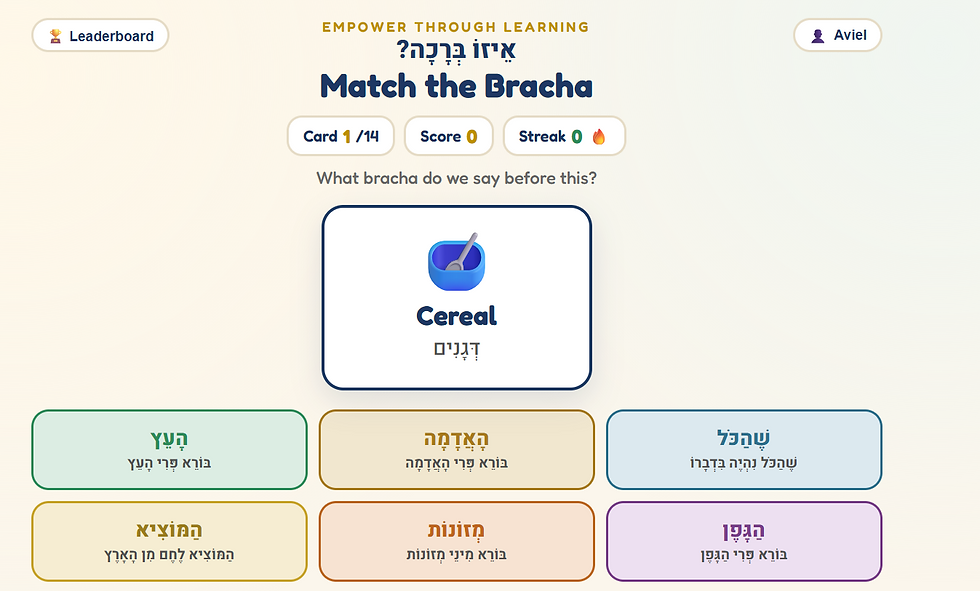
Match the Bracha shows a food on the screen with no answer, and the child taps the blessing they think it gets.
It runs from a Beginner level with three blessings and hints, up to an Expert level with all six, a countdown clock, and real meals like pizza and cholent where you have to work out which ingredient is the main one.
It remembers which foods each child finds hard and brings those back more often, and there's a leaderboard. Works on a phone, tablet, or computer. A few minutes before dinner is plenty.
In one sentence
EmPower thru Learning students at Perth Hebrew Congregation learned the six brachot over food through a blindfold taste test and a sorting game, and discovered why the blessing after a bread meal is the only one the Torah commands directly.
FAQ
What is a bracha?
A bracha is a Jewish blessing said over food.
It's a short pause to acknowledge where the food comes from and thank Hashem before eating.
How many blessings are there before food?
Six.
The three most common are Ha'etz (tree fruit), Ha'adamah (food from the ground), and Shehakol (everything else).
The others are Hamotzi (bread), Mezonot (grain foods), and Hagafen (grape juice and wine).
Why do we say a blessing after eating?
The Torah commands it in Devarim 8:10.
The blessing after a bread meal, Birkat Hamazon, is the only blessing required directly by the Torah rather than set up by Chazal (Our Sages).
What does hakarat hatov mean?
It means recognising the good. It's the idea behind every bracha:
noticing what you have, before and after you use it.
What is EmPower thru Learning? EmPower thru Learning is Perth Hebrew Congregation's program for learning Judaism and Hebrew,
open to students from a range of backgrounds and levels.
Want to be part of programs like this?
Sign up for EmPower thru Learning term 3 is open now!

Comments